Summary
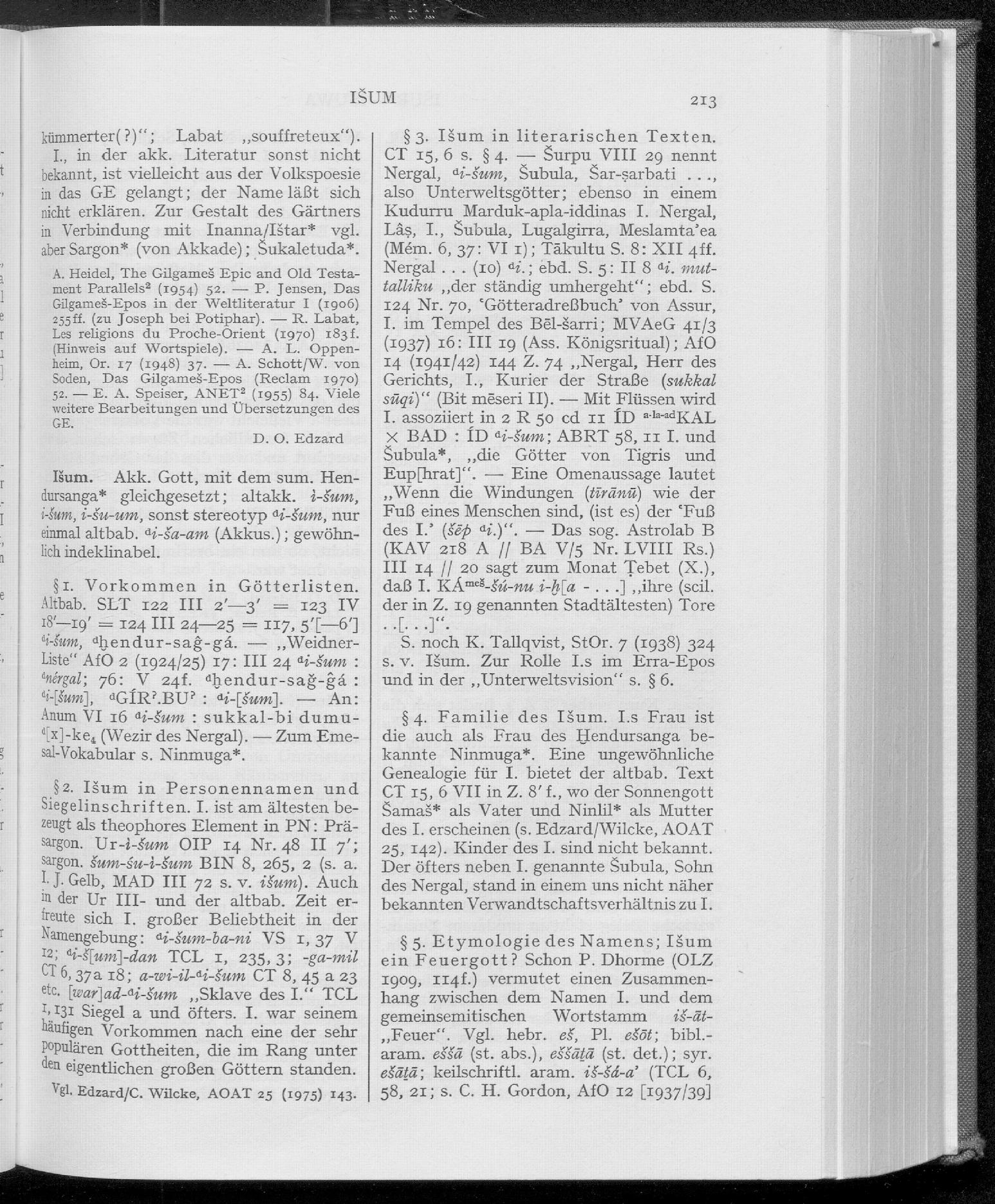
Ishum is an Akkadian god, herald of the gods and guardian of the streets at night, the companion who walks before Erra, god of war and plague. He is equated with the Sumerian Hendursag, the god list An = Anum makes him vizier of Nergal, and another text calls him "courier of the street". He was one of the most popular gods in personal names from pre-Sargonic times on: "Servant of Ishum", "Ishum is creator".
His story is a Babylonian poem of the first millennium BCE called Erra and Ishum, which opens in his praise: "Išum, zealous butcher whose hands are suited to bear his fierce weapons", and then addresses him: "You alone are the torch, it is your light they look to! You alone are the champion." Erra lies in bed like a man who has not slept, unable to decide whether to rise or sleep on; the Seven, his warriors, urge him to war, and he tells Ishum: open the path, come before me. Ishum takes pity on the people and says: warrior Erra, why have you devised insidious plots against the gods? You have plotted to ravage the earth and destroy its inhabitants; will you not desist? Erra does not desist, and goes to Marduk until Marduk rises from his throne.
In Tablet IV Ishum tells Erra what he has done: you have put the just to death, you have put the unjust to death, the man who sinned against you and the man who did not, old men on the porch and young girls in their bedrooms, and still you will not rest. His words please Erra like the best oil, and Erra says: they shall slay one another, and afterwards a man of Akkad shall rise up and fell them all and shepherd the rest; go, Ishum, take full discretion for the words you spoke. Ishum goes with the Seven to Mount Hehe and destroys it. In Tablet V Erra sits among the gods and says: when I am enraged I devastate people and do not distinguish just from unjust; what would happen if Ishum, who goes before me, were not there? Ishum answers: warrior, be still and listen to my words; what if you were to rest now, and we would serve you? Erra's face brightens like the dawning of a new day and he enters his dwelling. Ishum speaks the decisive word for the scattered people of Akkad: may the reduced people of the land become numerous again, may short and tall walk its paths, may the angry gods return to their dwellings, may the Tigris and Euphrates bring the waters of abundance. The poem ends: Erra became angry and set his face to destroying countries, but Ishum his counsellor placated him so that he left a remnant.
The idea his story turns on is that rage is stopped not by a weapon but by the words of a companion. Ishum does not fight Erra or bar his way; he walks ahead of him, then tells him what he has done just as it was, and Erra sees himself in the telling and grows calm. The torch that goes in front is the one that sees the road, and when it sees it, it leaves someone on it to walk. So a late Assyrian text calls him "his counsellor, the intercessor, who spares life, who loves truth".
We read the name in the Arabic tongue like this, as a reading proposed on the method: the Babylonian essay does not read his name, only that of his master Erra, as arra, to kindle and burn. The Akkadian name is written i-šum, and the final m is the mark of the nominative. Scholars since Dhorme have linked it with the Semitic word for fire: Hebrew ʾēš, Aramaic ʾeššā, Akkadian išātum. We read it with Arabic ʿishwa: Lane gives a fire seen by night from afar, to which one repairs seeking light, or a firebrand; ʿashā ilā n-nār, he made for the fire by night, guided by its light. The opening i of the Akkadian word stands where ʿ dropped, since Akkadian does not keep ʿ, and š is sh. That is Ishum in the poem: the torch whose light they look to, the watchman who walks by night.
Linguistic Root
Forms of the name
| Form | Use |
|---|---|
| ì-šum, i-šum, i-šu-um | Old Akkadian |
| ᵈi-šum | The usual later spelling, mostly uninflected |
| ᵈi-ša-am | Once, accusative, Old Babylonian |
| ᵈḫendur-saĝ-gá | The Sumerian counterpart in the god lists |
Fire and torch
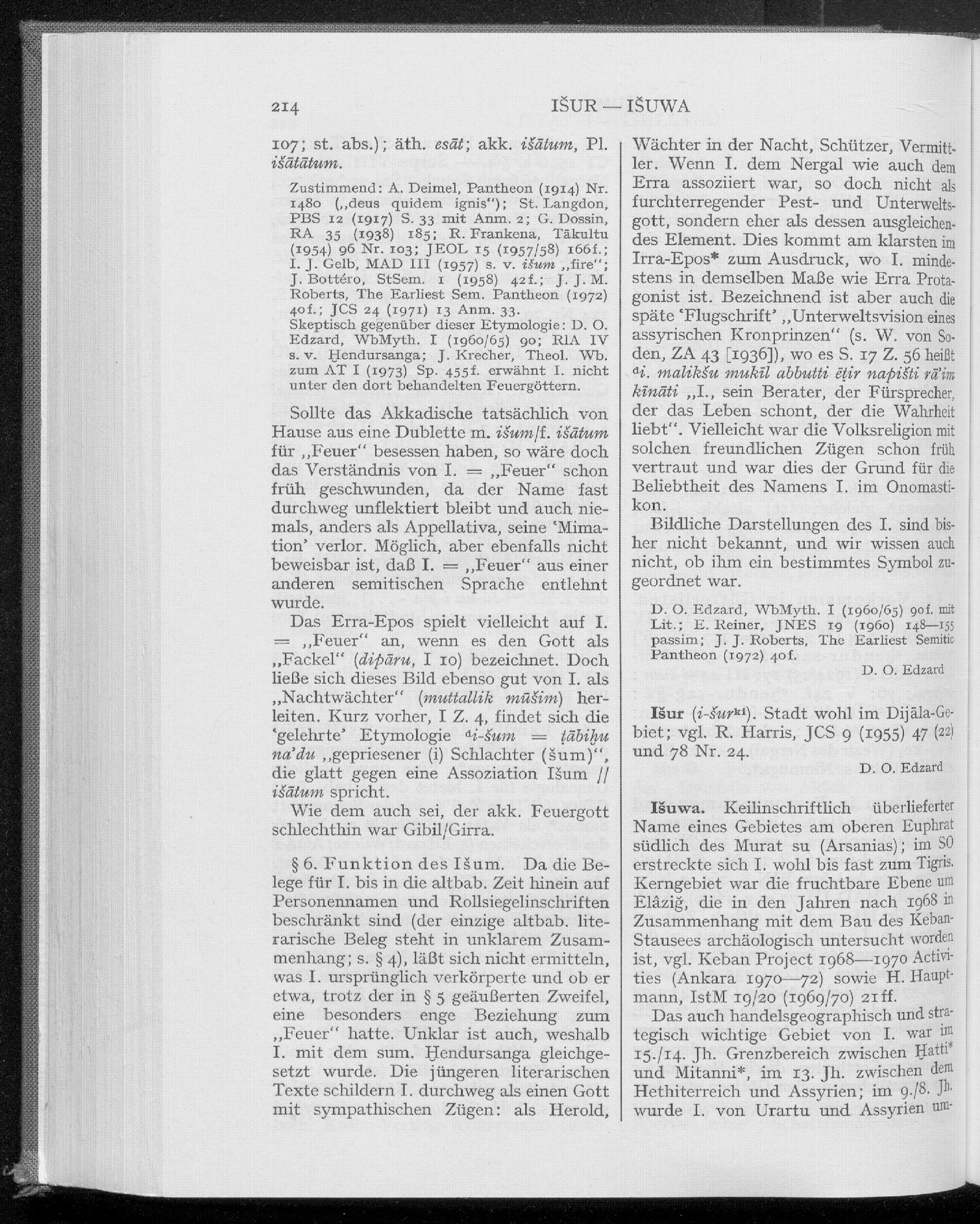
Edzard reports that Dhorme proposed in 1909 that the name comes from the common Semitic stem for fire, followed by Deimel, Langdon, Dossin and Gelb, while others doubted it. If Akkadian once had a pair išum (masculine) and išātum (feminine) for "fire", he writes, the sense was lost from the name early, since it is almost never inflected and never lost its mimation as common nouns did. The poem may allude to "fire" when it calls Ishum the "torch", dipāru, in Tablet I 10, but the image could as well come from Ishum as "night watchman", muttallik mūšim. Line 4 of the same poem offers a learned etymology of its own: "Išum, the praised butcher", reading šum as Sumerian "slaughter".
ʿIshwa
The reading covers the stem iš-; the final m is the nominative suffix, and the i is taken as the place of ʿ. Arabic does not keep the Semitic fire word with ʾ, but it keeps with ʿ the words ʿashw, ʿishwa and ʿāshiya: Lane, ʿashawtu ilā n-nār, I looked at the fire and made for it by night, seeking to be guided by its light; ʿishwa, a fire seen by night from afar, to which one repairs, or a firebrand; ʿāshiya, anyone who makes by night for the fire of a host. The word is a night fire that guides the walker, which joins the two images Edzard names, the torch and the night watchman. The Babylonian essay reads Erra as arra, the fire that burns; the two companions are then two fires, one that burns and one that guides.
What remains is that Hebrew and Ethiopic write the Semitic fire word with ʾ, not ʿ, and Akkadian cannot tell the two apart, so we do not know whether the word began with ʾ or ʿ. The reading stays open.
Key Mythic Narratives
Watchman of the streets and Nergal's herald
Before the poem Ishum is known only from personal names, seals and god lists. Šurpu names him with Nergal and the gods of the underworld; another text says "Nergal, lord of judgment, Išum, courier of the street"; an Assyrian list gives him a place in the temple of Bēl-šarri; other texts associate him with the rivers Tigris and Euphrates. His wife is Ninmuga, and an Old Babylonian text makes him the son of the sun god Shamash and Ninlil. The later texts all describe him as a kindly god: herald, watchman by night, protector, mediator; where he is joined with Nergal and Erra, it is not as a god of plague but as the one who balances their wrath. No image or symbol of his is known.
The sages and the Flood
In Tablet I of the poem Marduk reminds Erra of the day he grew angry and sent the Flood, and how he sent the seven sages back down to the Apsu. The poem in which Ishum calms Erra carries the memory of an earlier destruction in which there was no one to calm the god. Flood myth
Symbolic Reading
The Babylonian essay reads Erra as "the one who strikes with disease", plague in person, and from the root arra, to kindle and burn. If Erra is the blaze that takes just and unjust alike, Ishum is the fire in the watchman's hand that lights the road and does not burn it. The poem itself became an amulet: its end says that the musician who sings it will not die in an epidemic, and that the sword of judgment will not come near the house where this tablet is placed, even if Erra is angry and the Seven storm; so the words that calmed Erra once are carried to calm him every time.
Cross-Cultural Parallels
His nearest counterpart in Mesopotamia is Ninshubur, Inanna's minister: both are viziers who go between their lord and others, and both save by their words. But Ninshubur asks the gods to bring her mistress back, while Ishum asks his own lord to stop.
Among the Persians Sraosha is the sleepless watchman of the night, who strikes Wrath after sunset and wakes the cock against the dark. He and Ishum are two guardians who walk in the dark, and both stand against fury: Sraosha strikes Aēšma, the demon of wrath, and Ishum calms Erra's wrath with words.
Among the Greeks Hermes is the messenger of the gods and lord of roads, who goes ahead of others as a guide. He differs from Ishum in that Hermes uses tricks, while Ishum tells his companion only what he has done.